

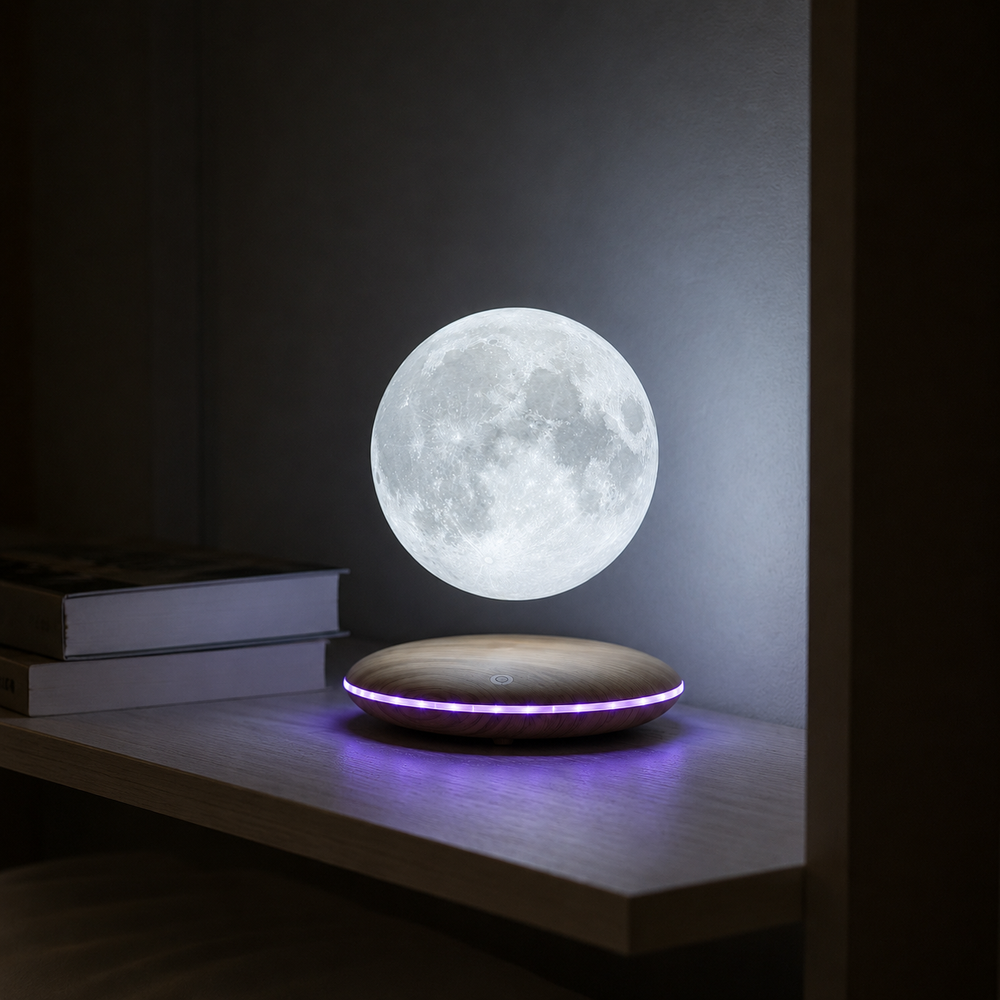
Nothing holds it up. And nothing has to turn it.
One Button Runs It. The Ones Underneath Do Nothing.
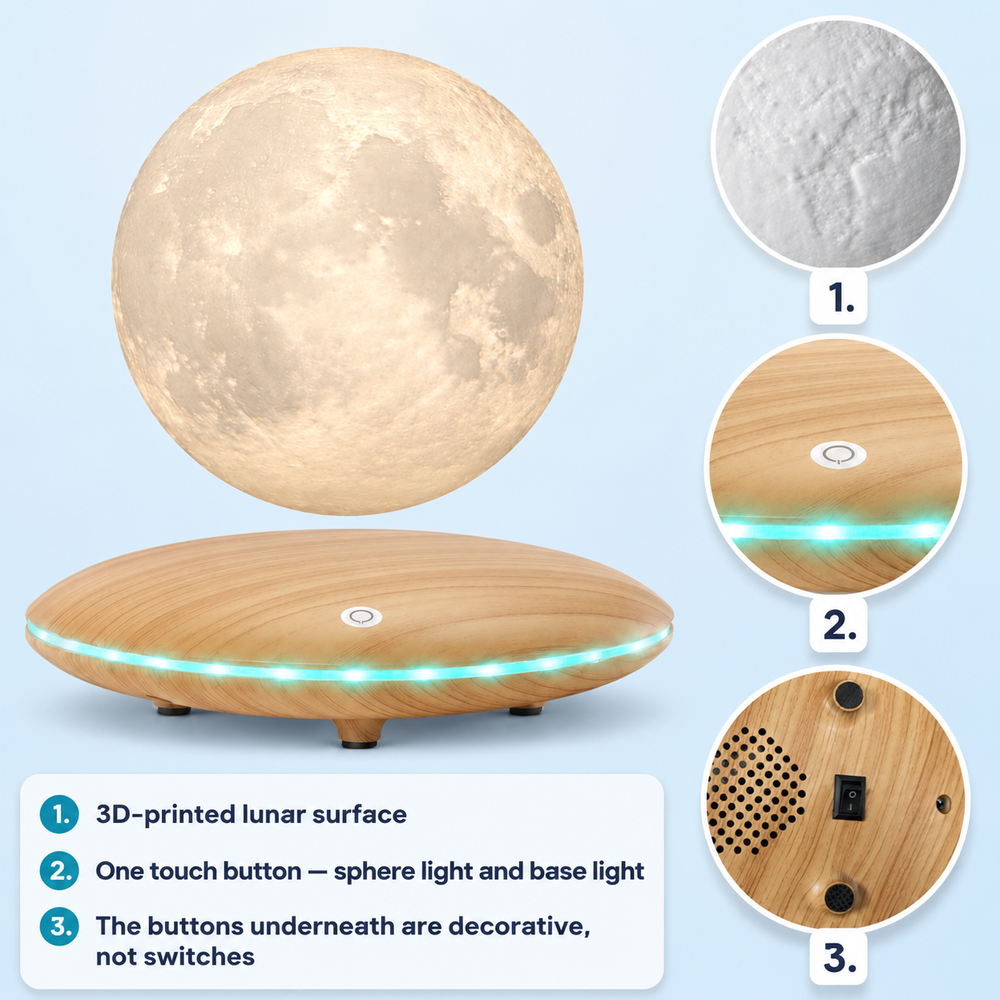
A single touch button on top of the base switches both the sphere and the rim light. There is no remote, so nothing to lose and nothing to reach for either. The two buttons on the underside of the base are decorative, not switches — worth saying out loud, because otherwise you find out by pressing them.
- One Button Runs It. The Ones Underneath Do Nothing.
- A single touch button on top of the base switches both the sphere and the rim light. There is no remote, so nothing to lose and nothing to reach for either. The two buttons on the underside of the base are decorative, not switches — worth saying out loud, because otherwise you find out by pressing them.
Three Modes, White Through To Yellow
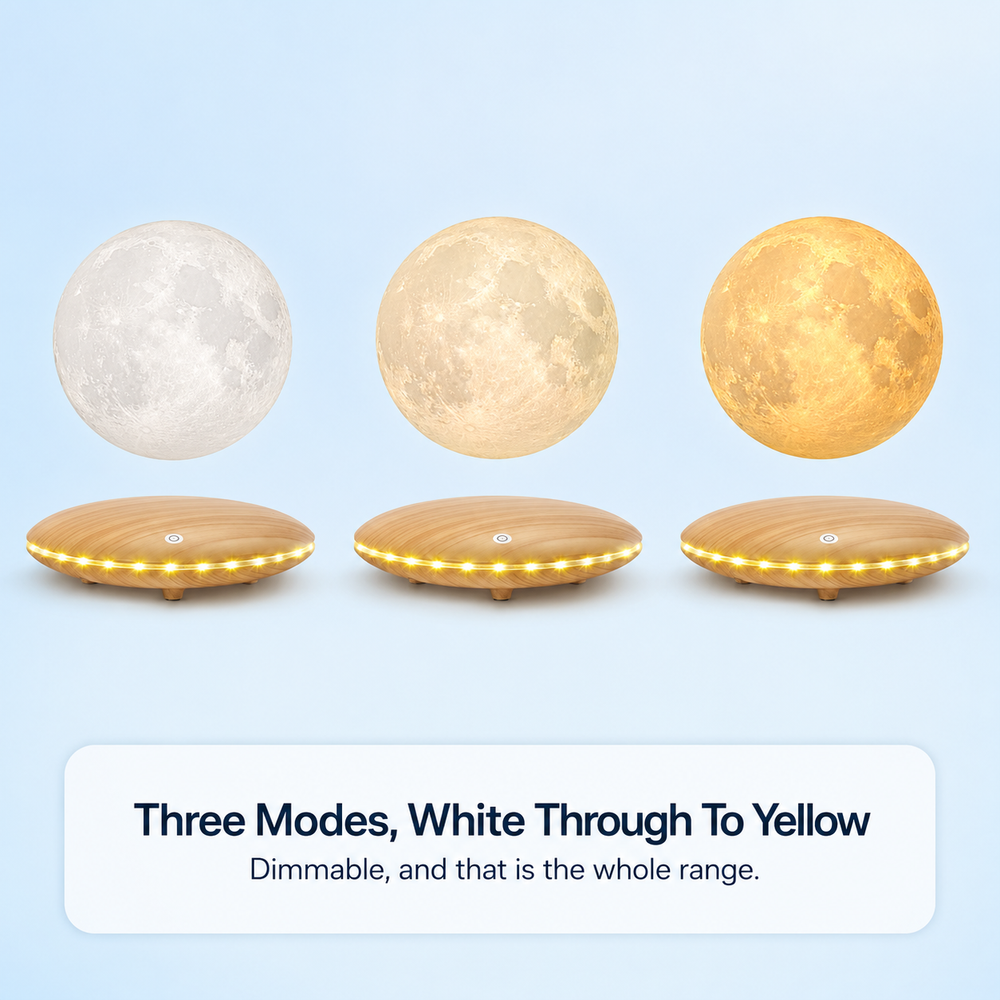
Cool white, soft warm white and a deep yellow, all dimmable. That is the full range and it is a narrower one than the RGB moons: what you get instead is a moon that always looks like a moon rather than a coloured ball.
- Three Modes, White Through To Yellow
- Cool white, soft warm white and a deep yellow, all dimmable. That is the full range and it is a narrower one than the RGB moons: what you get instead is a moon that always looks like a moon rather than a coloured ball.
The Base Runs Its Own Colours
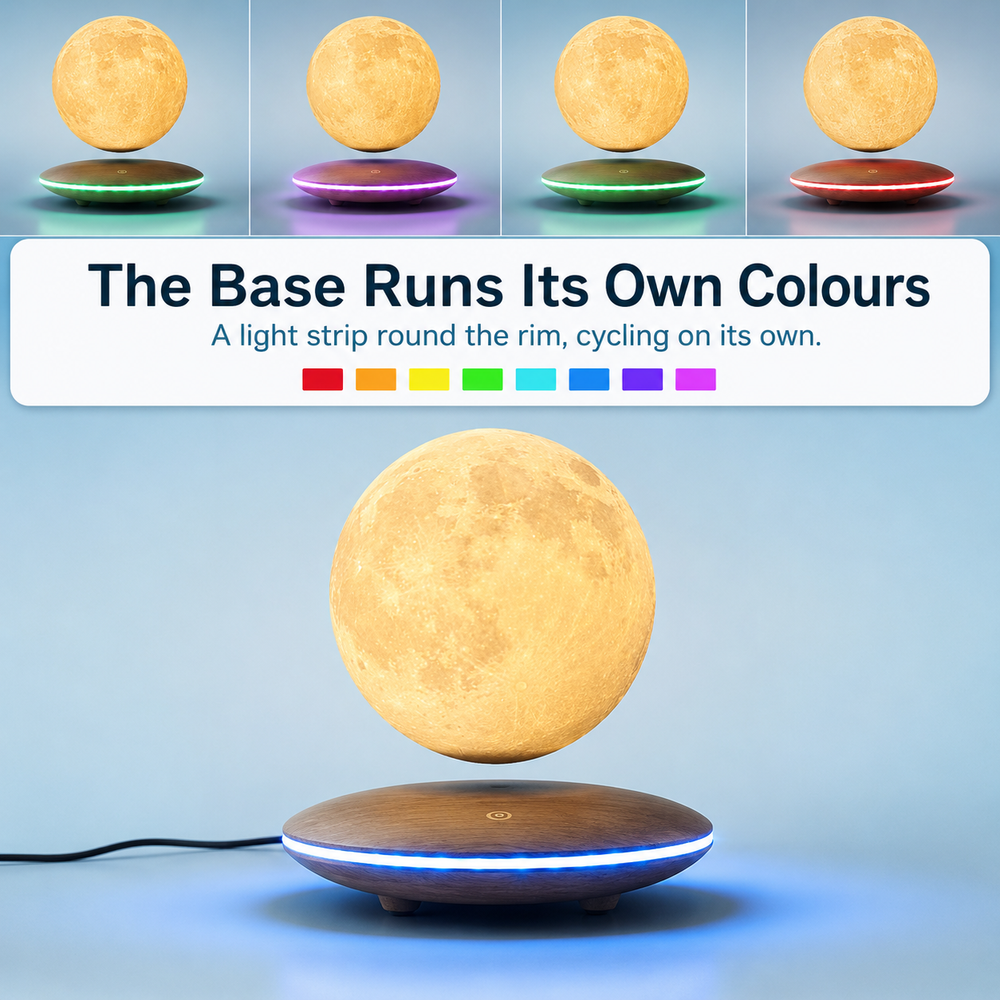
A light strip runs around the rim of the oval base and cycles through colours on its own, laying a coloured ring on the table under a plain white moon. It is the part that makes people look twice in a dark room.
- The Base Runs Its Own Colours
- A light strip runs around the rim of the oval base and cycles through colours on its own, laying a coloured ring on the table under a plain white moon. It is the part that makes people look twice in a dark room.
Getting It Up Takes A Minute
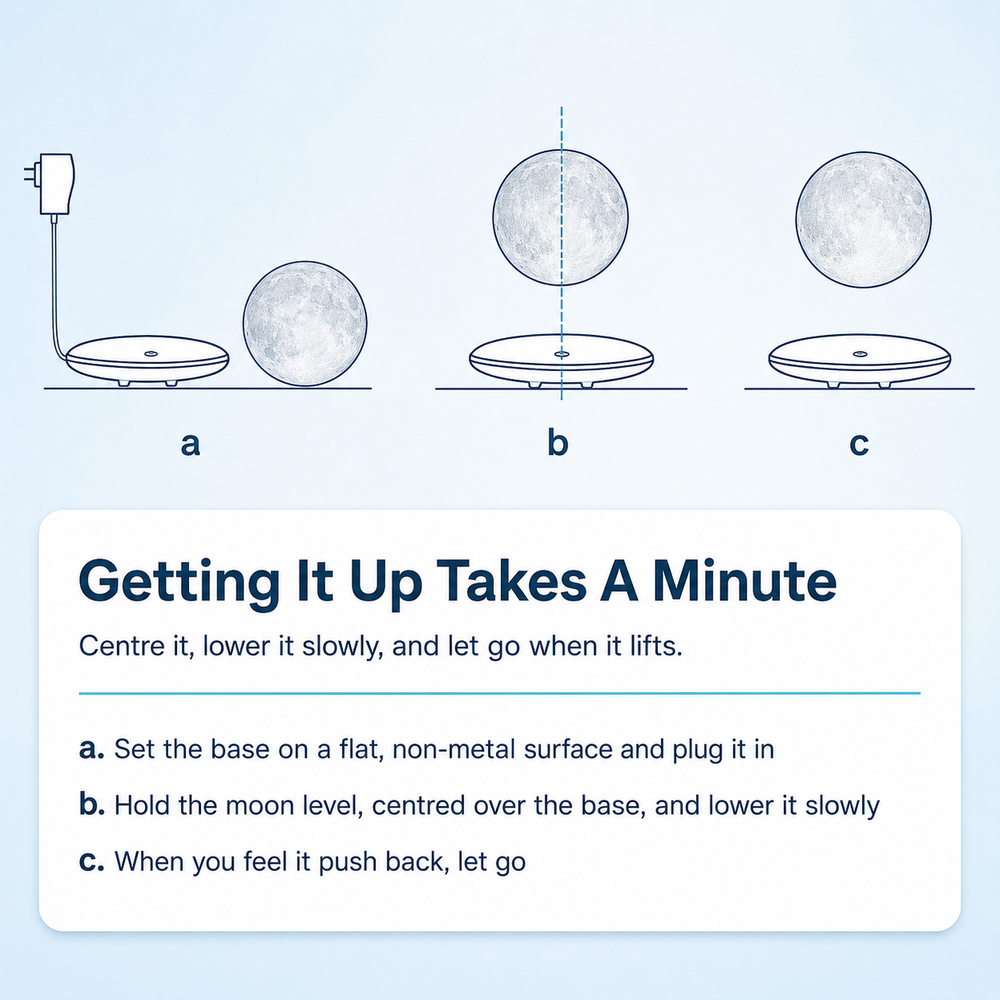
Flat, non-metal surface; base plugged in; hold the moon level over the centre and lower it until you feel it push back, then let go. Expect a few tries the first evening. After that it stays put and you never do it again.
- Getting It Up Takes A Minute
- Flat, non-metal surface; base plugged in; hold the moon level over the centre and lower it until you feel it push back, then let go. Expect a few tries the first evening. After that it stays put and you never do it again.
Get it floating once. Then just leave it.
One Button Runs It. The Ones Underneath Do Nothing.
A single touch button on top of the base switches both the sphere and the rim light.
Three Modes, White Through To Yellow
Cool white, soft warm white and a deep yellow, all dimmable.
The Base Runs Its Own Colours
A light strip runs around the rim of the oval base and cycles through colours on its own, laying a coloured ring on the table under a plain white moon.
Getting It Up Takes A Minute
Flat, non-metal surface; base plugged in; hold the moon level over the centre and lower it until you feel it push back, then let go.
How we compare.
What a floating moon does that one sitting on a stand cannot.
Frequently asked
questions.
The questions people actually ask before buying one.
Magnets in the base. The sphere sits in the field they make and holds an inch or two clear of the wood with nothing touching it from any direction. The same base sends power across that gap, which is why no cable ever runs into the sphere.
Yes. Once it is floating it turns slowly on its own axis without being pushed, and keeps going as long as it is up.
The sphere has three modes, dimmable, running from cool white through warm white to a deep yellow. It does not do blue, purple, red or green. The light strip around the base is the part that changes colour, and it does that by itself.
No. One touch button on top of the base does everything, so there is nothing to lose — and also no way to switch it off without walking over to it.
Nothing. They are decorative, not switches. It is an odd bit of design and it is better said here than discovered by pressing them.
Not hard, but not first time either. Flat non-metal surface, base plugged in, hold the moon level over the middle and lower it slowly until you feel the push, then let go. A few tries the first evening and that is usually that.
The sphere is 5.9 inches across, about the size of a grapefruit, over a flattened oval wooden base of roughly the same width. The base runs off the mains, so put it somewhere a socket reaches and leave clear air above it.
Free U.S. shipping and a 30-day return window. Set it up, live with it for a week, and send it back if it is not what you pictured.