

Four ports for the birds. A moat for everything else.
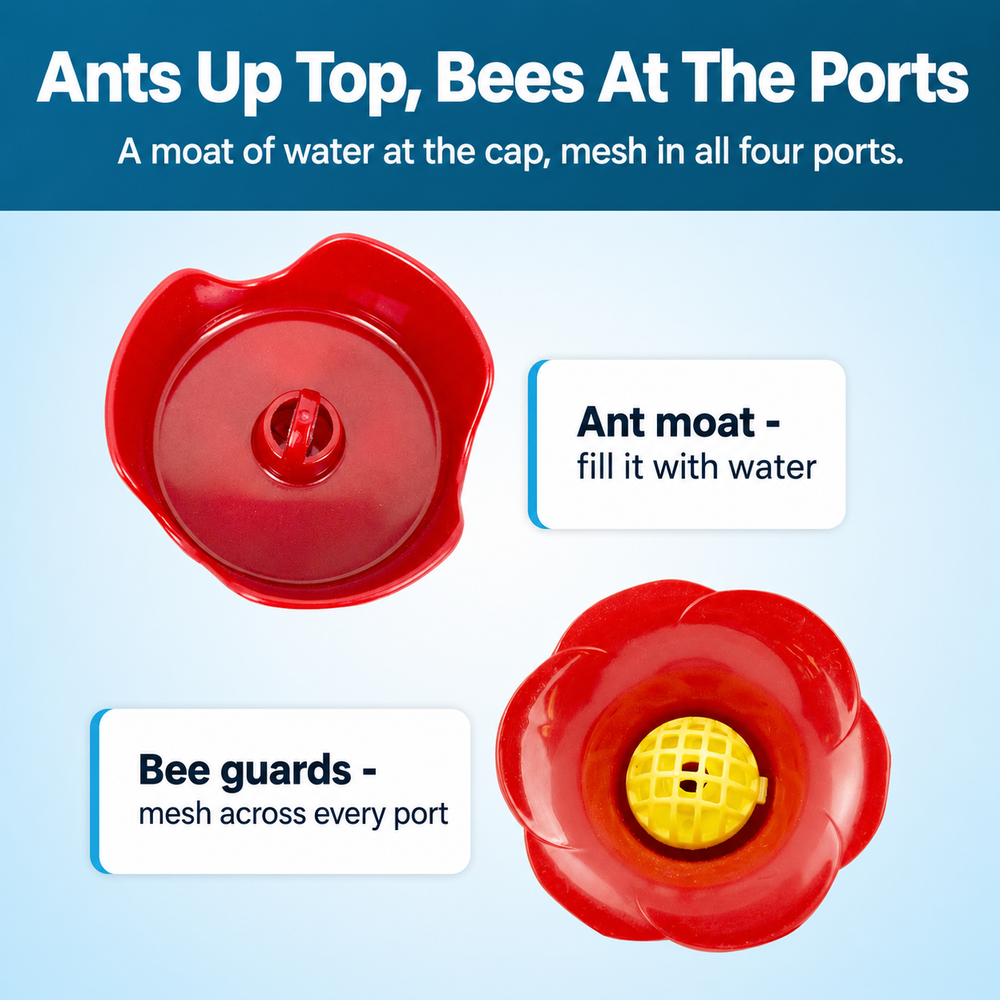
Ants Up Top, Bees At The Ports
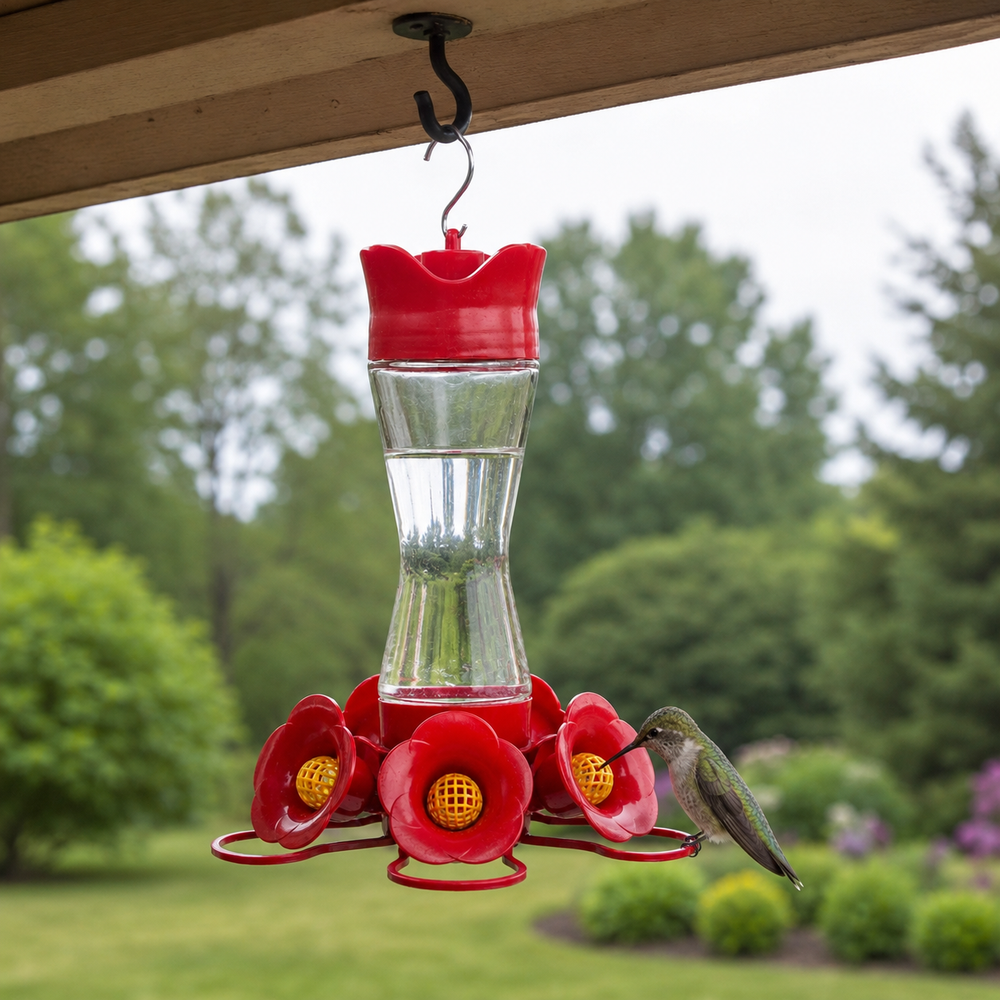
The cap is a shallow dish you fill with water, so ants coming down the hook reach it and stop. Lower down, a yellow mesh guard sits in the middle of every flower port, keeping the nectar below the lattice rather than at the surface of an open hole. Two different problems, handled in two different places.
- Ants Up Top, Bees At The Ports
- The cap is a shallow dish you fill with water, so ants coming down the hook reach it and stop. Lower down, a yellow mesh guard sits in the middle of every flower port, keeping the nectar below the lattice rather than at the surface of an open hole. Two different problems, handled in two different places.
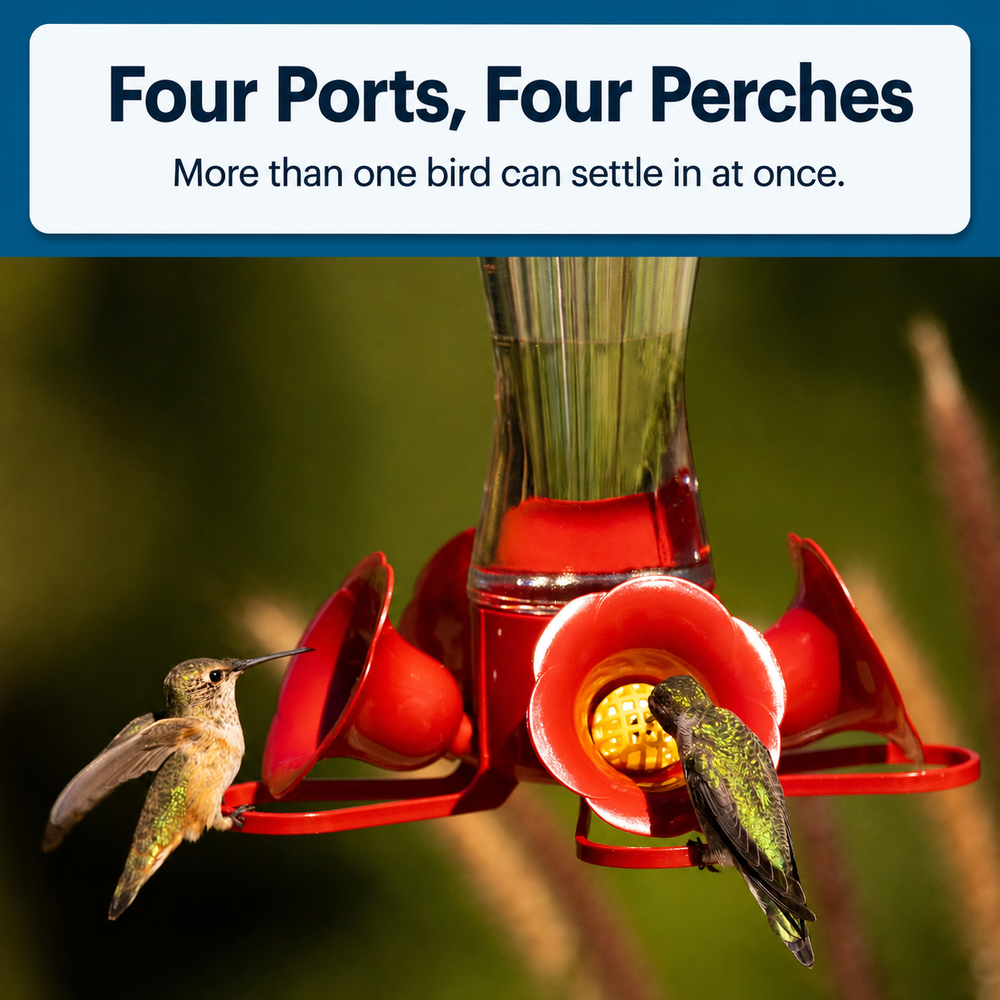
Four Ports, Four Perches
Four flower-shaped ports are spaced around the base, and each one has its own U-shaped perch underneath it. Hummingbirds will hover to feed, but they would rather sit, and a bird that can perch stays at the feeder far longer — which is the difference between a blur going past the window and something you get to watch.
- Four Ports, Four Perches
- Four flower-shaped ports are spaced around the base, and each one has its own U-shaped perch underneath it. Hummingbirds will hover to feed, but they would rather sit, and a bird that can perch stays at the feeder far longer — which is the difference between a blur going past the window and something you get to watch.
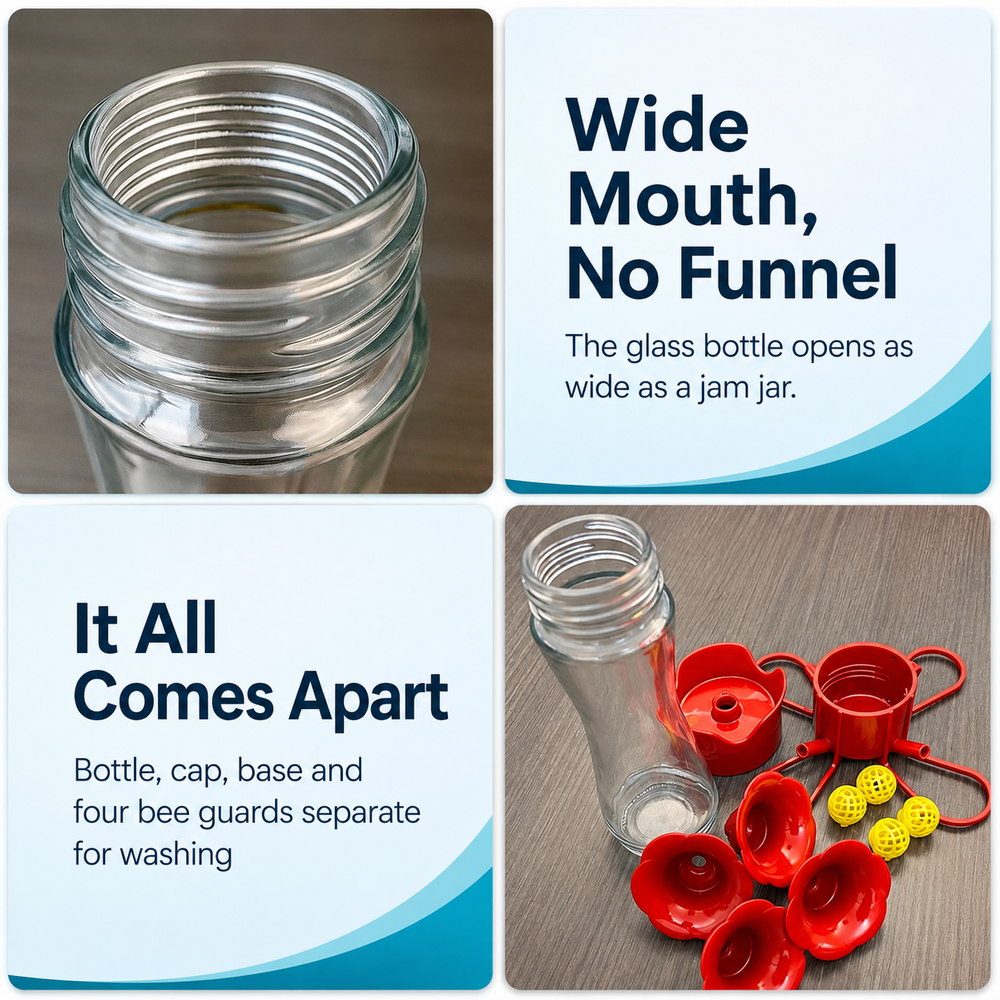
Wide Mouth, No Funnel
The glass bottle opens as wide as a jam jar, so filling it is a straight pour and washing it takes a bottle brush rather than patience. Cap, base, bottle, the four ports and the four bee guards all separate, which means every surface the nectar touches is a surface you can actually get at.
- Wide Mouth, No Funnel
- The glass bottle opens as wide as a jam jar, so filling it is a straight pour and washing it takes a bottle brush rather than patience. Cap, base, bottle, the four ports and the four bee guards all separate, which means every surface the nectar touches is a surface you can actually get at.
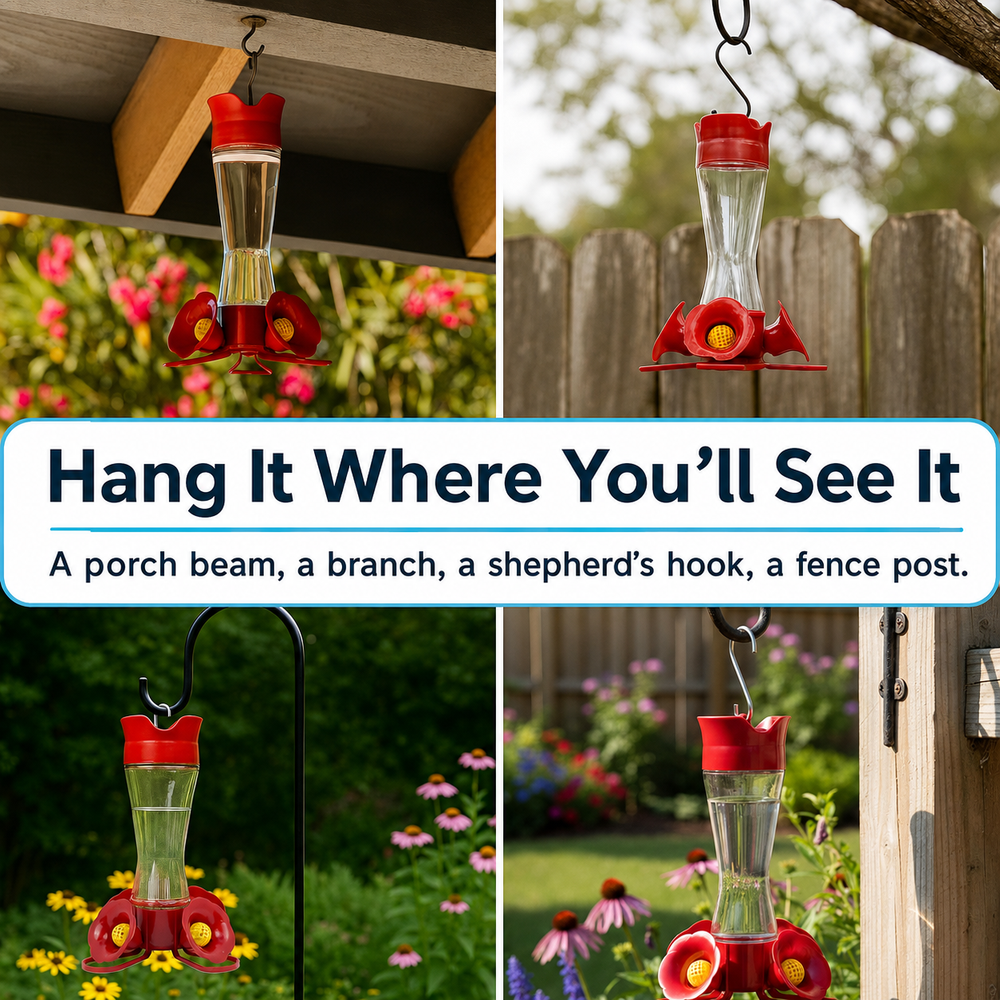
Hang It Where You'll See It
One metal S-hook through the top cap, and it will go on a porch beam, a low branch, a shepherd’s hook in a border or a bracket on a fence post. Give it a little clear air on every side so birds can come in from any direction, and put it in front of a window you sit at.
- Hang It Where You'll See It
- One metal S-hook through the top cap, and it will go on a porch beam, a low branch, a shepherd’s hook in a border or a bracket on a fence post. Give it a little clear air on every side so birds can come in from any direction, and put it in front of a window you sit at.
Hang it by a window. Give it a week.
Ants Up Top, Bees At The Ports
The cap is a shallow dish you fill with water, so ants coming down the hook reach it and stop.
Four Ports, Four Perches
Four flower-shaped ports are spaced around the base, and each one has its own U-shaped perch underneath it.
Wide Mouth, No Funnel
The glass bottle opens as wide as a jam jar, so filling it is a straight pour and washing it takes a bottle brush rather than patience.
Hang It Where You'll See It
One metal S-hook through the top cap, and it will go on a porch beam, a low branch, a shepherd’s hook in a border or a bracket on a fence post.
How we compare.
What a glass feeder with a moat and mesh guards does that a plain one does not.
Frequently asked
questions.
The questions people actually ask before buying one.
The top cap is moulded as a shallow open dish. You pour water into it, and ants coming down the hanging hook reach that water and stop — they will not walk through it to get to the nectar below. It needs topping up: water goes down faster than nectar in hot weather, and a dry moat is just a dish. Make it part of the same job as checking the feeder.
Each of the four ports has a yellow mesh guard set into it, so the nectar sits below the lattice instead of at the surface of an open hole. A hummingbird’s bill passes through the mesh; blunter mouthparts do not reach. Insects will still take an interest in a sweet thing hanging in a garden — the guards mean they have far less to work with, not that they never turn up.
8 fl oz of nectar, in a clear glass bottle you can read at a glance from indoors. It is a small feeder on purpose: nectar goes off in warm weather, so a smaller batch tends to be a fresher one.
The maker publishes no height or width for this one, so we are not going to quote you a figure we cannot stand behind. What is published, and what actually matters when you are deciding: it holds 8 fl oz, it has four ports and four perches, and it is a compact bottle feeder rather than a large reservoir. If you need an exact clearance for a bracket, measure the space and allow for a hook.
Yes — a clear glass hourglass bottle that screws down onto the red base on a moulded glass thread. The cap, base, ports and perches are plastic; the bottle is not. Glass stays clear, which is the practical reason to want it: you can see how much is left without taking anything down.
Take it apart. The cap lifts off, the base unscrews from the bottle, the four flower ports pull out and the four bee guards come out of the ports. Wash everything in hot water, rinse it well and let it dry before refilling. In warm weather do that every few days, at the same time you change the nectar.
From the metal S-hook through the top cap — a porch beam, a low branch, a shepherd’s hook in a flower bed or a bracket on a fence post all work. Leave a little clear air around it so birds can approach from any side, and pick a spot you can see from inside. Near flowering plants helps birds find it in the first place.
Free U.S. shipping and a 30-day return window. Hang it, give it a week or two, and send it back if it is not what you pictured.